A Leatherhead garden with an unloved patch of grass behind the kitchen. We built a composite deck with a custom pine balustrade — the boards handle the weather, the timber does the joinery.
Composite Decking with Pine Balustrade in Leatherhead: Outdoor Build in Surrey
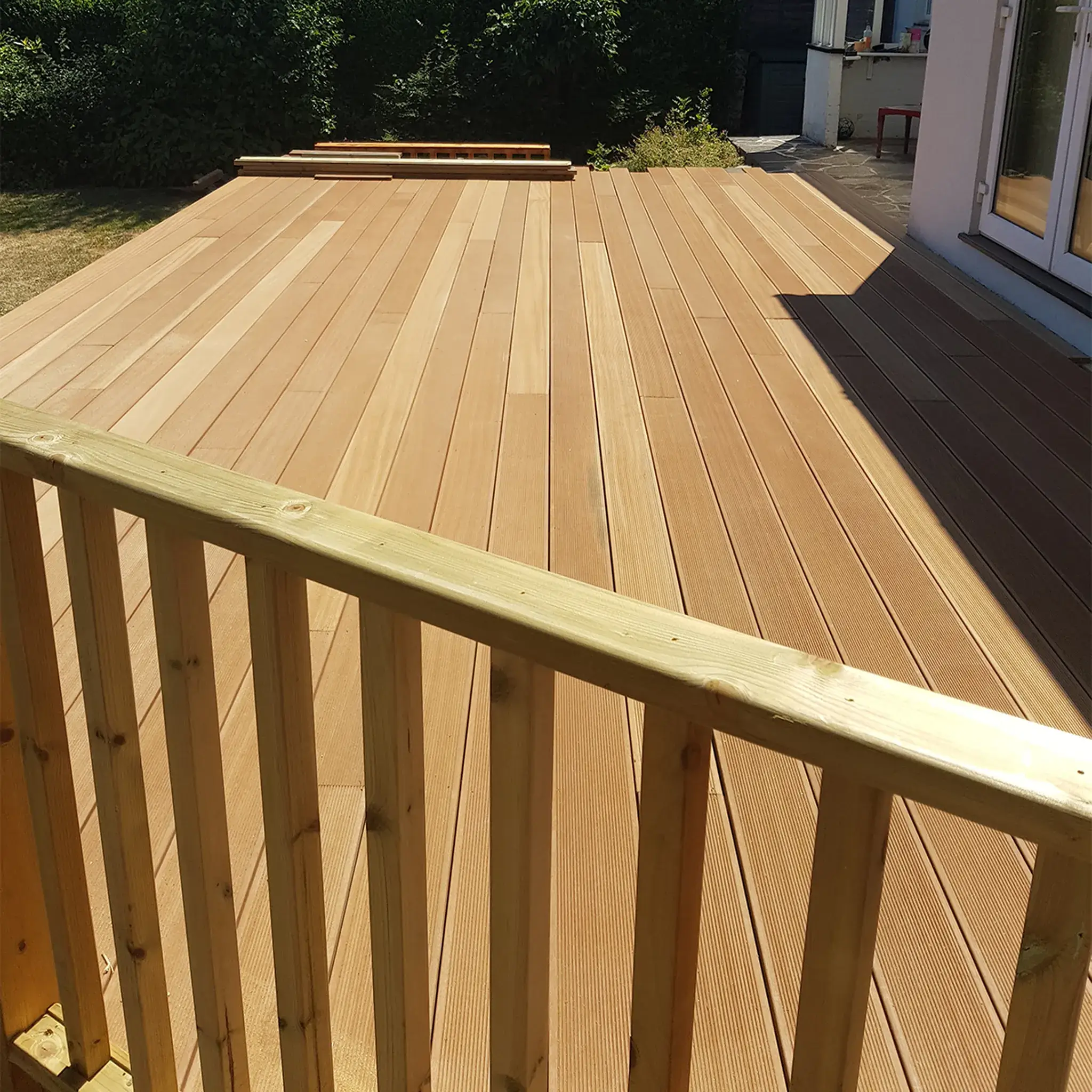
The brief in Leatherhead was clear: the clients wanted a deck behind the kitchen that they could use without thinking about maintenance. They'd had a timber deck before — it had looked good for two years, then started to grey, split and lift at the edges. They weren't interested in oiling it every spring. Composite boards were the obvious answer for the deck surface.
The balustrade was a different decision. Composite balustrade systems exist but they're expensive and the posts tend to look thick and plastic in a garden setting. We suggested natural pine instead — pressure-treated, well-detailed at the joints, and in keeping with the timber fence that ran around the rest of the garden. The combination worked: composite boards for the horizontal surface, timber for the vertical structure.
Why Composite Boards Paired with Timber Balustrades
Composite decking boards are a mixture of wood fibre and plastic resin — they don't rot, don't splinter, don't need treating, and hold their colour without UV fading. For a deck surface that people walk on and sit at, they're the sensible choice in a British climate.
But composite isn't always the right material for the structure above the deck surface. Balustrade posts need to be fixed securely into the frame, jointed precisely at the top rail, and detailed where they meet the deck boards. That's timber joinery — it's what we do, and it's faster and cleaner in timber than in composite profile systems that rely on clip-together parts.
Pressure-treated pine, properly jointed and painted or stained, will last fifteen to twenty years in an outdoor setting. The maintenance is a coat of stain every three to four years — less demanding than untreated hardwood, and the result looks more considered than a plastic post and rail system.
Building the Subframe
The deck sat on a concrete pad that was already in place — previous owners had poured it, which saved us the groundwork stage. We fixed 150×50mm treated joists across the pad on adjustable pedestals, set at 400mm centres to give the composite boards a solid bearing at the recommended spacing for the profile we used.
Getting the frame level matters more with composite than with timber boards. Timber can be face-fixed and the slight surface variation doesn't show. Composite boards clip into hidden fixings on the joist face — if the joists run at different heights, the board joints open and close unevenly and it's visible from the house. We checked level across the full frame before any boards went down.
The balustrade posts were fixed to the outer joist with through-bolts before the decking went on — once the boards are down, access to the outer joist face is awkward and the fixing isn't as clean. Post positions were set out so the top rail would land at 1100mm above the finished deck surface — the current building regulation requirement for decks above 600mm from ground level. This deck was lower than that, but we built to the standard anyway.
Laying the Composite Boards
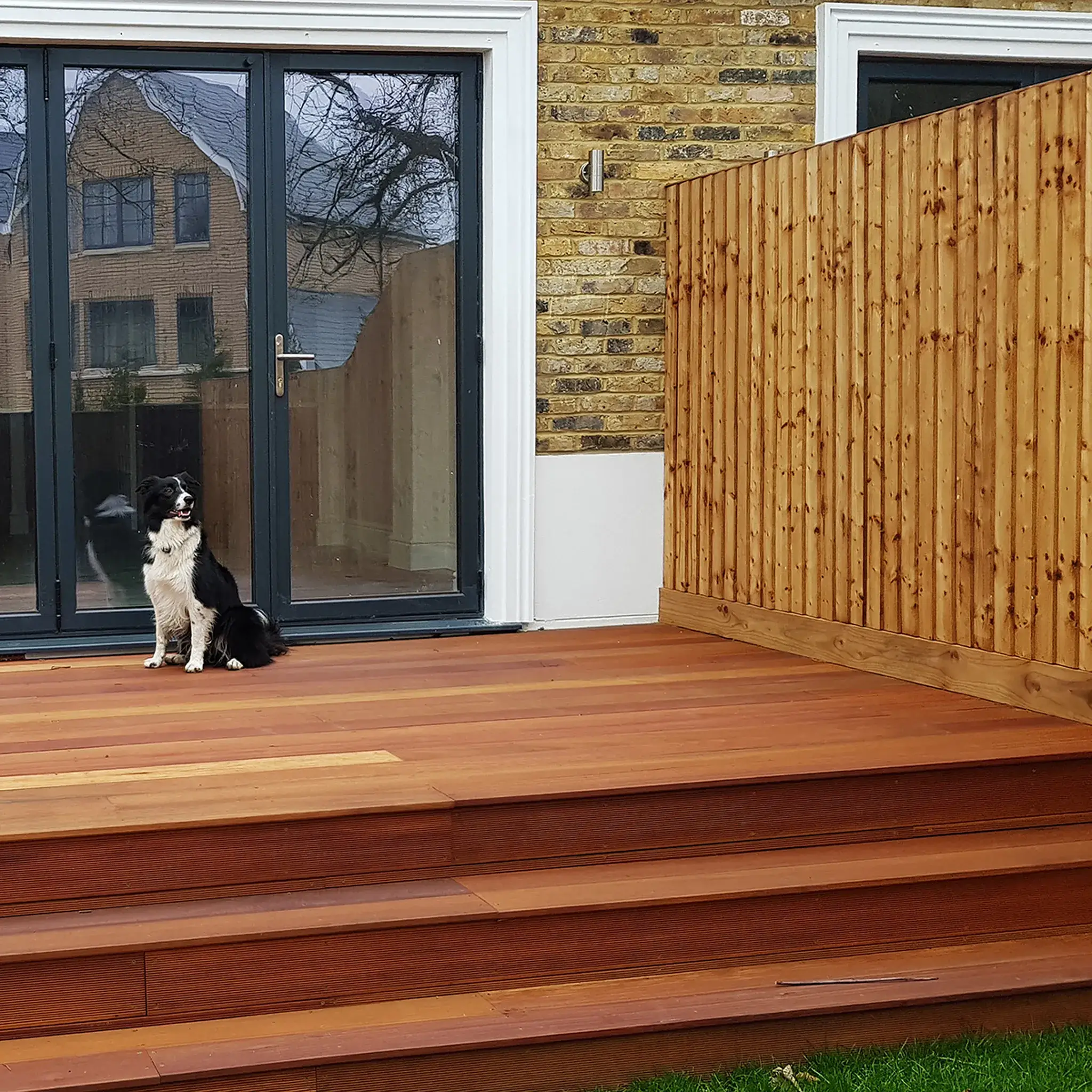
The boards ran parallel to the house — a practical choice because it meant off-cuts were at the far end of the deck rather than at the kitchen door, and the shadow gap between boards read as horizontal lines when viewed from inside the kitchen. Board direction is a small decision that affects how the finished deck reads from the main viewpoint.
We used a hidden fixing system: a clip sits on the joist face and the board grooves over it. No screw heads on the surface, no plugs. The end trim — a solid composite fascia board — covered the joist ends and the post bolt heads on the outer edge.
Cutting around the post bases was the fiddliest part of the day. Composite boards cut cleanly with a fine-toothed saw blade, but the cuts around the square posts needed to be tight — any gap draws the eye.
The Pine Balustrade
The balustrade was the part of the job that took the most time and produced the most visible result. Four 100×100mm pine posts, fixed to the outer joist, with a 95×45mm top rail tenoned into each post. The infill was 40mm square spindles — mortised into the bottom rail and top rail, spaced at 100mm centres so the gap between each spindle stayed below the 100mm maximum under Part K of the building regulations.
The top rail profile was a simple rounded-over section, routed on site. It feels solid when you lean on it — that's the test. A balustrade that moves when you push it won't pass inspection and won't feel right in use.
We finished the timber with two coats of a dark grey exterior stain, which matched the existing fence panels and tied the deck into the rest of the garden rather than making it look like a separate project dropped in from somewhere else.
The Finished Result
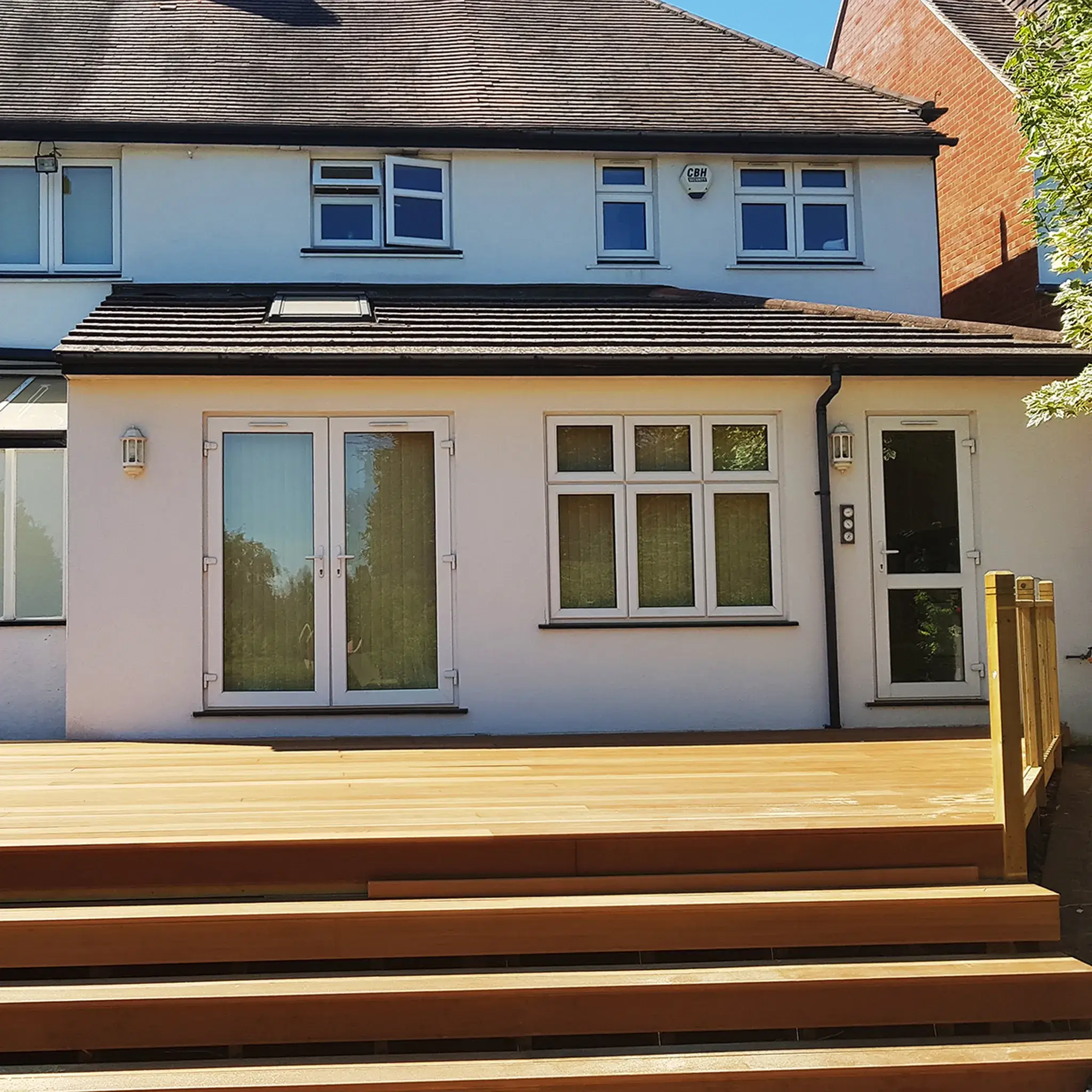
The deck in Leatherhead is used most evenings from April through to October. The composite surface looks the same as it did on day one — no greying, no lifting, nothing to treat. The pine balustrade had its first coat of maintenance stain in year three. That's the outcome the clients wanted: a space they use, not one they manage.
The combination of composite boards and timber joinery is one we'd recommend for most residential deck projects in Surrey and South London. You get the durability of composite where it matters most — the walking surface — and the precision and character of timber where it shows most — the balustrade.
Frequently Asked Questions — Composite Decking in Surrey and South London
How long does composite decking last compared to timber?
Most composite decking manufacturers quote twenty-five years or more for the boards themselves. In practice, the frame and substructure — which is usually treated timber — will need attention before the surface does. The boards in a well-built composite deck should outlast two or three timber decks of similar quality. The trade-off is higher upfront cost and the fact that composite can't be sanded or refinished if it gets scratched.
Does composite decking get hot in the sun?
Yes — dark-coloured composite boards absorb heat and can get noticeably warm underfoot on a sunny afternoon. This is more pronounced in south-facing gardens. Lighter board colours run cooler, and some composite ranges include a capped surface that's more resistant to heat absorption. It's worth discussing colour choices in relation to aspect before committing to a board specification.
What subframe do you need for composite decking?
Treated timber joists at 400mm centres are the standard approach for residential decks. The joist depth depends on the span between supports — for the Leatherhead project, 150×50mm C16 joists on adjustable pedestals were appropriate. Aluminium joist systems are an alternative for areas where ground contact moisture is a concern, but they're more expensive and not always necessary in a standard garden setting.
Do I need planning permission for a composite deck in Surrey?
In most cases, no — a deck that doesn't raise the level more than 300mm above the original ground level and doesn't cover more than half the garden area falls within permitted development rights. A deck next to a listed building or within a conservation area needs to be checked with the local authority. We advise on this at the planning stage for every project.
Do you build decks in areas outside Leatherhead?
Yes — we cover Leatherhead, Sutton, Kingston, Wimbledon, Croydon and the wider Surrey and South London area. Outdoor carpentry including deck builds and garden structures is part of our joinery and carpentry service.
📞 Free quote for your decking project: +44 7824 534416 |